Garden Pathway Moonlighting: The Art of Downlit Atmosphere
Some links may earn Veluce a commission at no extra cost to you. Purchases, delivery and returns are handled by the retailer. Affiliate disclosure.
Quick Takeaways
- Moonlighting operates from above to shape spatial mood
- Light sources must remain visually hidden
- Warm 2700K preserves natural lunar perception
- Spacing defines tonal rhythm, not navigation
- The system prioritizes perception over direction
Light That Falls
Natural moonlight reveals space without instruction. Forms appear without full definition, and depth is inferred rather than presented.
Moonlighting replicates this condition using elevated concealed sources that wash downward across paths and planting. The result is not a lit route, but a softened field of visibility.
Unlike ground lighting, which structures movement, moonlighting structures perception. It changes how space is read, not how it is traveled.
This defines the A-axis: ambient field behavior rather than directional control.
What Is Pathway Moonlighting?
Moonlighting places light above circulation zones and allows it to fall naturally onto ground and planting layers.
The fixture is never exposed. Only its effect exists.
It works best in transitional or experiential garden zones — spaces intended for wandering rather than efficient movement. It reduces visual hardness without removing clarity.
It is not navigation. It is environmental tone.
Moonlighting vs Other Systems
Moonlighting (A-axis): Elevated concealed light creating an ambient field. Shapes atmosphere, not movement.
Path lighting (Z-axis): Ground-level light guiding movement rhythm. Directional, functional, circulation-focused.
Uplighting (Y-axis): Ground-upward light revealing vertical structure. Perception-focused, dramatic shadow creation.
System context:
- X (Gathering): Fire Pit Tables — social convergence
- Y (Perception): Tree Uplighting — vertical structure
- Z (Circulation): Pathway Lighting — directional movement
- A (Atmosphere): Pathway Moonlighting — ambient field
Where It Works
| Setting | Role |
|---|---|
| Garden paths | Softens transitions |
| Woodland spaces | Reinforces natural canopy light |
| Seating zones | Creates low-glare enclosure |
| Water features | Enhances reflection behavior |
| Thresholds | Reduces spatial abruptness |
Not suitable for service routes or primary circulation paths requiring clarity and speed.
The Principle of Concealment
The system depends on one rule:
The light source must never compete with the space it defines.
Installation parameters:
- 15–25 ft elevation
- fully concealed from path sightlines
- downward-controlled beam spread
If the fixture is visible, the system becomes decorative lighting rather than atmospheric design.
Spacing and Atmospheric Density
Spacing defines density, not direction.
| Spacing | Effect |
|---|---|
| 15–20 ft (curves) | Continuous wash |
| 20–30 ft (straight paths) | Rhythmic separation |
| 30+ ft | Sparse atmospheric points |
Curves require tighter spacing to preserve continuity. Straight sections tolerate wider intervals.
Color Temperature and Perception
| Temp | Effect |
|---|---|
| 2700K | Natural, moonlike diffusion |
| 3000K | Neutral warmth |
| 4000K+ | Breaks atmospheric realism |
Moonlight is inherently warm and diffuse. Higher temperatures introduce artificial sharpness.
Mounting Contexts
| Type | Use |
|---|---|
| Trees | Best diffusion and concealment |
| Structures | Controlled architectural application |
| Pergolas | Structured garden zones |
| Poles | Substitute when natural elevation is absent |
Trees remain the most effective due to organic light fragmentation.
A low-voltage route for directional moonlighting
Where a wired installation is practical, low-voltage directional fixtures give you more consistent output than solar and make it easier to build a coordinated system. For tree-mounted applications, use an appropriate non-invasive mounting method and avoid damaging mature trunks or branches.
- → Browse the 12V directional landscape/tree spotlight — use only where the mounting method and beam direction suit the intended downward-lighting effect.
- → Browse the 220V-to-12V/24V outdoor transformer — keeps the garden-lighting circuit on the low-voltage side after conversion.
- → Browse IP68 low-voltage cable connectors — useful for protected outdoor joins and branch runs.
Layered Garden Light System
Moonlighting operates as part of a four-layer spatial system:
- Ambient (A-axis): Moonlighting — environmental field
- Movement (Z-axis): Path lighting — direction
- Structure (Y-axis): Uplighting — vertical form
- Social (X-axis): Fire — gathering point
The Experience of Arrival
At dusk, the garden does not activate — it emerges.
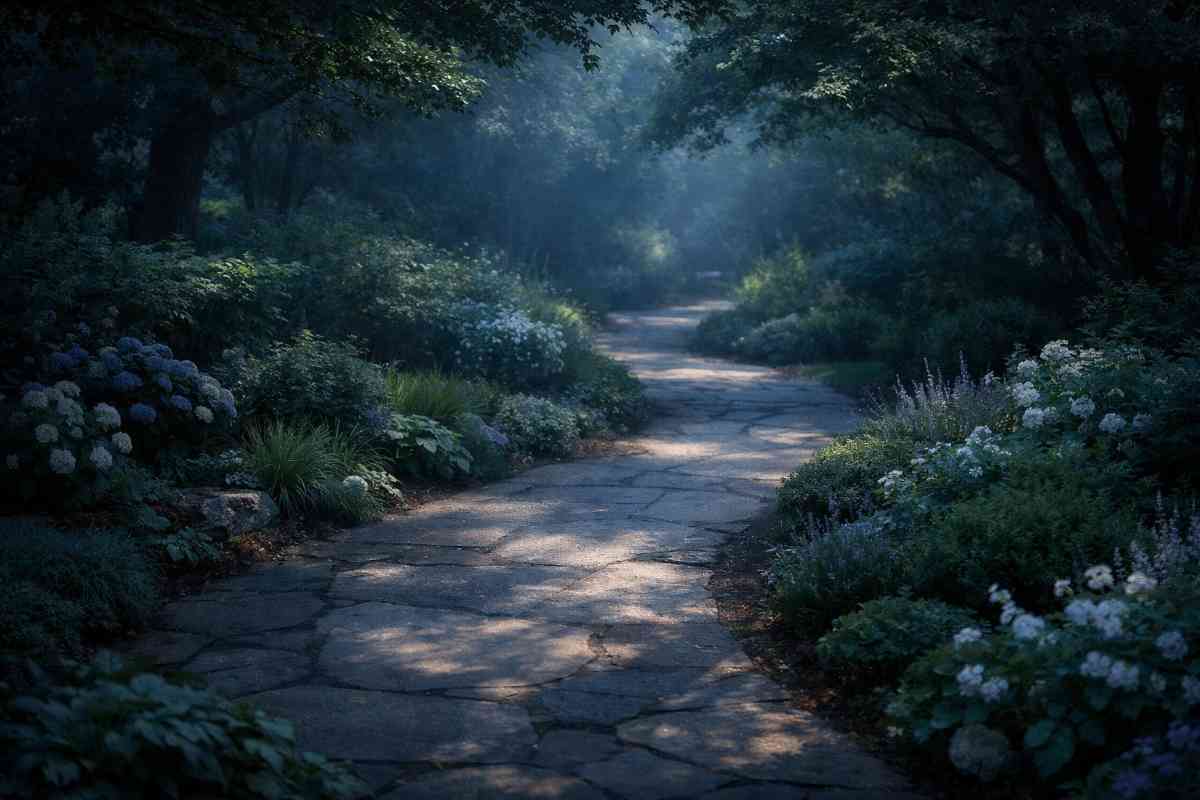
Light appears indirectly, from above perception rather than within it. Surfaces become legible without being defined. Edges remain unresolved.
Movement becomes interpretive, not instructed.
Common Mistakes
- Visible fixtures in sightlines
- Cool white disrupting natural reading
- Excess brightness removing ambiguity
- Over-spacing on curves
- Treating system as functional path lighting
Installation Principles
- Establish elevated concealment points
- Maintain downward controlled diffusion
- Use 2700K consistently
- Adjust spacing to geometry, not uniform grids
- Prioritize invisibility over precision
Maintenance
- Clean lenses to preserve diffusion quality
- Adjust for canopy growth
- Maintain consistent color temperature
- Replace degraded sources before tonal shift occurs
Frequently Asked Questions
How bright should it be?
Bright enough to reveal surfaces without defining them.
Can it be used on curves?
Yes, with tighter spacing to preserve continuity.
Best mounting location?
Any elevated structure that allows full concealment.
Difference from path lighting?
Path lighting directs movement. Moonlighting shapes perception.
Best color temperature?
2700K warm white.
The Hierarchy of Garden Light
With all four axes now defined, the complete spatial model emerges:
The 4-Axis Spatial Model:
- X (Fire Pit Tables): Horizontal gravity — social convergence. Warm, flickering, central.
- Y (Tree Uplighting): Vertical gravity — perception hierarchy. Directed upward, shadow-creating.
- Z (Pathway Lighting): Directional gravity — movement logic. Pools on ground, rhythm-based.
- A (Pathway Moonlighting): Ambient gravity — atmospheric mood. Soft, diffuse, from above.
Together, they form a complete spatial operating system for outdoor experience design.
For the complete guide to fire as horizontal gravity, see Fire Pit Tables. For trees as vertical gravity, see Hidden Uplighting for Mature Trees. For pathway movement as directional gravity, see Garden Pathway Lighting.
The Bottom Line
Moonlighting is not illumination. It is controlled concealment of light above the field of view.
It does not guide movement. It alters how movement is perceived.
A well-designed garden does not become visible at night. It becomes legible.
Take the Moonlighting Idea into a Full Plan
Moonlighting is strongest when it works with paths, planting, focal points and darker pauses. The Veluce Outdoor Lighting Blueprint helps you map those relationships before you start adding fixtures.
Explore More
Browse the VELUCE shop → VELUCE Collection
Save ideas for later → VELUCE on Pinterest