Fire Pit Tables: The New Centerpiece of Luxury Outdoor Living
Quick Takeaways
- Fire pit tables combine warmth, ambiance, and surface function in one piece
- Gas (propane/natural gas) offers convenience; wood-burning provides authenticity
- Materials range from concrete and stone to stainless steel and tile
- Safety requires proper clearance from structures and furniture
- Glass fire beads reflect light beautifully and resist debris accumulation
The Space Between Fire and Furniture
Fire is chaos made visible. It flickers. It dances. It refuses to stay still.
The fire pit table is the opposite. It contains that chaos, frames it, elevates it to the exact height where conversation lives. What could have been wild becomes architectural. What could have been temporary becomes permanent.
This is the quiet contradiction at the heart of luxury outdoor design: control versus instinct. Order versus atmosphere. The safety of architecture versus the draw of open flame.
Fire as Architectural Gravity
Why does fire naturally become the center of outdoor architecture?
Because it satisfies something primal. Humans have gathered around flames for tens of thousands of years. The instinct doesn’t disappear when we install a gas line.
But in luxury design, fire isn’t just instinct — it’s a tool. A flame draws the eye. It defines a perimeter of comfort. It makes a patio feel like a room because it establishes a center.
A well-placed fire pit table doesn’t compete with its surroundings. It becomes the gravitational anchor around which everything else — seating, circulation, planting, lighting — naturally orients.
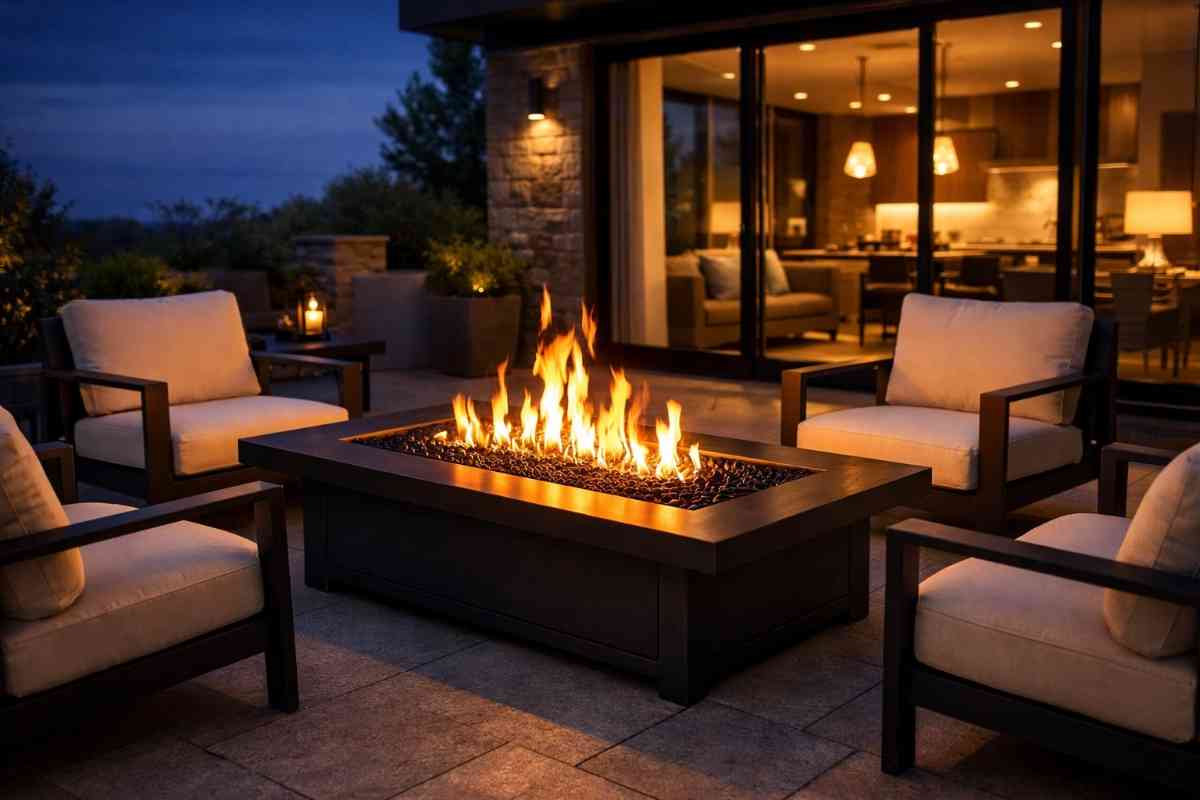
What Is a Fire Pit Table?
A fire pit table is an outdoor table with an integrated fire feature at its center. Unlike traditional fire pits, it combines a usable tabletop surface with adjustable heat and ambient lighting. Most modern versions use propane or natural gas, though wood-burning remains popular for those seeking authenticity over convenience.
Gas vs Wood Fire Pit Tables: Which Is Better?
The first decision is how you want your fire to burn.
Natural Gas
| Advantage | Consideration |
|---|---|
| Unlimited fuel supply | Requires professional gas line installation |
| No tank refills | Fixed location — cannot be moved |
| Clean burning, no smoke or ash | Lower BTU output than propane |
| Push-button or remote ignition | Higher upfront installation cost |
Best for: Permanent patios with existing gas lines, covered outdoor rooms, homeowners who want convenience.
Propane
| Advantage | Consideration |
|---|---|
| High BTU output (more heat) | Requires tank refills or exchanges |
| Portable — can be moved | Tank must be stored discreetly |
| No professional gas line needed | Propane is heavier than air (safety considerations) |
| Clean burning, no smoke or ash | Tanks visible unless hidden in base |
Best for: Decks without gas lines, rental properties, flexible seating arrangements.
Wood-Burning
| Advantage | Consideration |
|---|---|
| Authentic crackling fire experience | Produces smoke and ash |
| Lower ongoing fuel costs if you have easy access to firewood | Requires cleaning after each use |
| Higher perceived ambiance | May violate local burning restrictions |
| Simpler technology | Sparks can be a concern near seating |
Important: Always check local regulations before purchasing a wood-burning model, particularly in wildfire-prone regions.
Best for: Rural properties, traditional aesthetics, homeowners who enjoy the ritual of building fires.
Which Fire Pit Table Is Right for You?
| If you… | Choose… |
|---|---|
| Have an existing gas line | Natural gas |
| Want flexibility to move your table | Propane |
| Love the ritual of building fires | Wood-burning |
| Prefer modern, reflective aesthetics | Glass beads |
| Prefer traditional, realistic flame appearance | Ceramic logs |
| Live near the coast | Aluminum or stainless steel construction |
| Experience freezing winters | Sealed stone, aluminum, or powder-coated steel |
| Want the lowest maintenance | Propane or natural gas with glass beads |
Built-In vs Freestanding
| Type | Best For | Key Considerations |
|---|---|---|
| Freestanding | Flexibility, renters, phased renovations | Portable, lower upfront cost, can move with you |
| Built-in | Permanent luxury renovations, seamless architecture | Higher resale value, becomes part of landscape |
Built-in fire features are treated as part of the landscape architecture rather than movable furniture, which is why they anchor higher-end outdoor renovations.
How Much Do Fire Pit Tables Cost?
| Type | Typical Price Range |
|---|---|
| Propane | $300 - $1,500 |
| Natural gas | $500 - $2,500+ |
| Luxury concrete/stone | $1,500 - $5,000+ |
| Custom built-in installations | $5,000 - $15,000+ |
Most residential gas fire pit tables produce between 30,000 and 60,000 BTUs, though larger luxury models can exceed 100,000 BTUs, offering comfortable warmth for intimate gatherings without overwhelming nearby seating.
While budget models exist, premium fire pit tables distinguish themselves through thicker materials, higher-quality burners, concealed fuel storage, and refined finishes that age gracefully outdoors.
What Designers Actually Prioritize
Designers don’t choose fire pit tables. They specify spatial anchors.
Burner performance over BTU ratings. A well-designed stainless steel burner outperforms a cheap burner with inflated specs.
Material honesty. Unsealed concrete that patinas. Natural stone with visible fossils. Steel that weathers. These age better than anything trying to look new forever.
Proportion to seating. The distance between flame and guest determines intimacy. Too far, and fire feels decorative. Too close, and it becomes uncomfortable.
Concealed fuel storage. Visible propane tanks ruin the illusion. Premium tables hide them completely.
Materials at a Glance
| Priority | Best Choice |
|---|---|
| Durability | Concrete, natural stone, powder-coated steel |
| Aesthetics | Natural stone, bronze, teak |
| Coastal climates | Aluminum, stainless steel |
| Freezing climates | Sealed stone, aluminum, powder-coated steel |
| Low maintenance | Aluminum, stainless steel |
Fire Glass vs Lava Rock vs Ceramic Logs: Which Is Best?
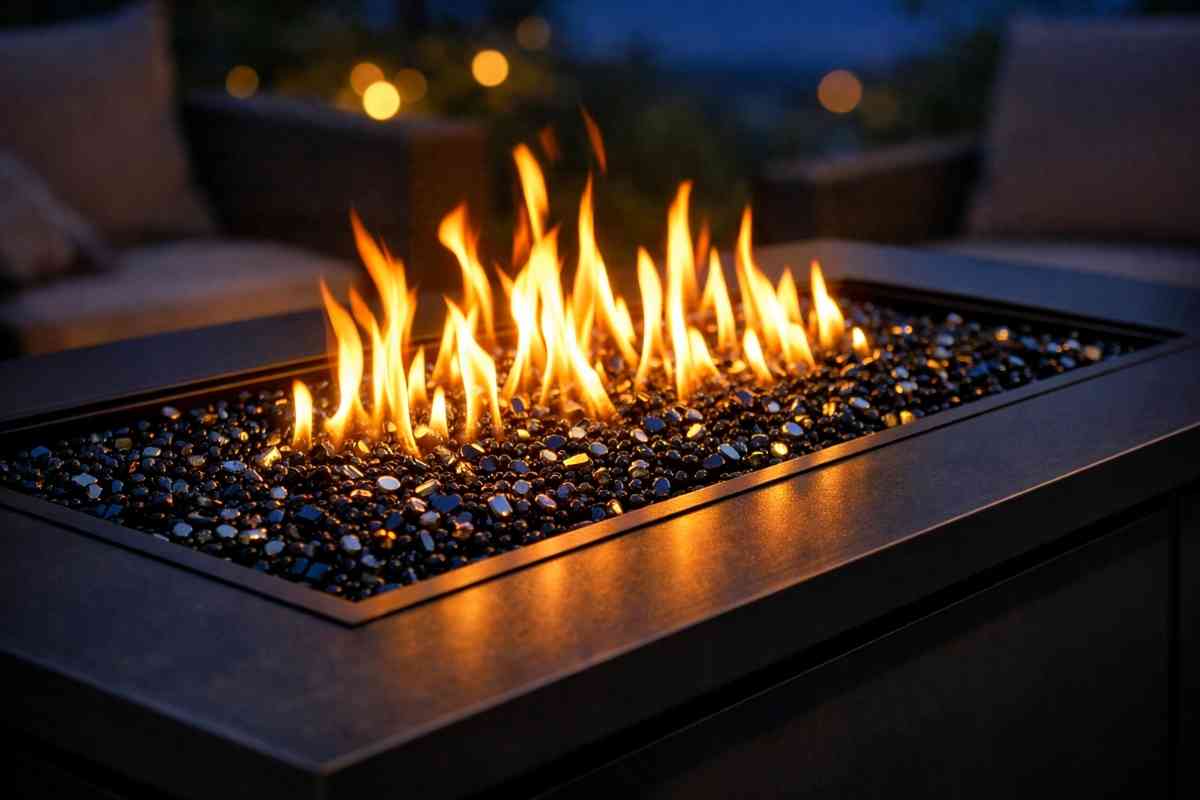
The material surrounding the flame shapes how light moves through the space.
| Media | Best For |
|---|---|
| Fire glass | Modern aesthetics, reflective shimmer, minimal maintenance |
| Lava rock | Natural, rustic, higher heat retention |
| Ceramic logs | Traditional, realistic flame appearance |
Fire glass has become the premium choice for contemporary designs. The tempered glass beads reflect flame light, creating a shimmering effect that pure fire cannot achieve.
Sizing + Placement
| Patio size | Table size | Seating distance |
|---|---|---|
| Small (under 200 sq ft) | 24-36 inches | 24-30 inches from flame |
| Medium (200-500 sq ft) | 36-48 inches | 30-36 inches from flame |
| Large (over 500 sq ft) | 48-60+ inches | 36-42 inches from flame |
Position your table so it becomes the natural destination point — visible from the house, accessible from seating, and balanced with path circulation around it.
Common Mistakes to Avoid
- Oversizing for your patio — a table that dominates the space feels overwhelming, not luxurious
- Underestimating wind exposure — wind dissipates heat; consider wind guards or sheltered placement
- Using wood-burning in restricted zones — many urban areas have burn bans
- Ignoring clearance spacing — furniture too close to flames degrades fabric and poses safety risks
- Choosing cool white fire glass — warm amber or neutral tones complement flame color better
Safety + Clearance
- At least 24 inches from furniture
- Around 36 inches from combustible walls
- Approximately 72 inches below overhead obstructions
- Never leave a burning fire pit unattended
- Professional installation recommended for gas lines
Layering Fire Pit Tables with Lighting
A fire pit table is rarely the only light source in a well-designed outdoor space. Designers approach outdoor spaces like interior lighting: a focal point, task illumination where needed, accent lighting for depth.
The flame provides warm ambient light. Path lighting guides movement. LED strips under seating define edges. Uplights on trees extend the garden beyond the patio.
For a complete guide to lighting layering, see our articles on LED Strip Integration for Modern Decks, Copper Lanterns That Age With Grace, and Upward Lighting: The Art of Architectural Grazing.
Seasonal Maintenance
Spring: Inspect burner, clean glass beads, test ignition
Summer: Wipe surfaces weekly, keep burner ports clear
Autumn: Clean thoroughly, apply protective cover
Winter: Store indoors or use breathable waterproof cover
Frequently Asked Questions
Are fire pit tables safe to use on a wooden deck?
Yes, with precautions. Use a heat shield or fire-resistant mat beneath the table.
What’s better: propane or natural gas?
Natural gas is more convenient with an existing line. Propane offers portability.
Can I leave my fire pit table outside in winter?
High-quality weather-resistant models can remain outdoors with a waterproof cover.
How much heat does a fire pit table produce?
30,000-60,000 BTUs typically provides comfortable warmth within a 5-8 foot radius in calm conditions.
Do fire pit tables require electricity?
Most do not. Many use piezo or battery-powered ignition.
What are fire glass beads made of?
Tempered glass. It won’t melt or discolor.
For homeowners drawn to timeless materials, our article on Copper Lanterns That Age With Grace explores another approach to selecting outdoor elements that improve with age.
The finest outdoor spaces are those that feel complete after sunset.
Are Fire Pit Tables Worth It?
For homeowners who regularly entertain outdoors, the answer is often yes. A fire pit table extends the usable season of a patio, creates a natural gathering point, and combines two functions in one piece of furniture. The ability to rest a glass on the edge while still enjoying the flame is one of those small luxuries many homeowners quickly come to appreciate.
The Bottom Line
Choose gas for convenience, wood for authenticity. Select materials that withstand your climate. Size appropriately for your space.
A fire pit table does not complete a patio. It reveals it.
Explore More
Browse fire pit–compatible lighting → VELUCE Outdoor Lighting Collection
Save fire pit design ideas → VELUCE Pinterest Board