Garden Pathway Lighting: The Architecture of Movement
Some links may earn Veluce a commission at no extra cost to you. Purchases, delivery and returns are handled by the retailer. Affiliate disclosure.
Quick Takeaways
- Pathway lighting is not about fixtures — it’s about the rhythm of movement
- The spacing between lights determines whether a path reads as continuous or discrete
- Light guides the body forward without conscious decision
- Darkness between pools of light is as important as the light itself
- The goal is comfortable navigation, not maximum illumination
The Unseen Choreography
A path during the day announces itself. You see where it begins, where it curves, where it ends. No thought required.
A path at night is different. It must be revealed — not all at once, but step by step. The garden decides how much to show and when. This is the quiet art of movement architecture: using light to guide without instructing, to beckon without announcing.
Between the fire pit (where people gather) and the trees (what people look at), pathways are what make them move without thinking. They are the circulation system of the outdoor room — invisible when working correctly, impossible to ignore when broken.
What Is Movement Architecture?
Movement architecture is the design of how people experience space over time. In gardens, it answers one question: Where does the body want to go next?
Pathway lighting is not about fixtures. It’s about rhythm. The spacing between lights. The brightness relative to surrounding darkness. The way a pool of light pulls you forward into the next pool, and the next, until you’ve crossed the garden without once thinking about where to place your feet.
This is different from tree uplighting (which anchors perception) and fire pit lighting (which anchors gathering). Pathway lighting is directional gravity — it points, it pulls, it completes the movement loop.
Together with fire (horizontal gravity) and trees (vertical gravity), pathways complete the circulation layer of outdoor space: directional movement.
The Physics of Light and Motion
Light doesn’t just reveal. It directs.
The human eye is instinctively drawn to the brightest thing in the field of vision. On a dark path, that thing should be the next step — not the fixture itself, not the garden beyond the curve, just the immediate surface in front of you.
This creates a subtle but powerful effect: movement without cognitive load. You don’t choose where to go. The light chooses for you, and you follow unconsciously.
In movement architecture, darkness is not absence — it is spacing, rhythm, and directional pressure.
| Light Behavior | Effect on Movement |
|---|---|
| Continuous line of light | Feels like a runway — fast, direct, unambiguous |
| Spaced pools of light | Feels like a rhythm — measured, contemplative, exploratory |
| Single light at destination | Feels like a target — moves attention to the end, not the journey |
| Darkness between pools | Creates compression — then release as the next pool appears |
Choosing the Right Solar Path Lights
Not all solar lights guide movement effectively. The fixture’s light distribution determines the quality of guidance.
| Distribution | Effect | Best For |
|---|---|---|
| Downward (shielded) | Pools of light on the walking surface | Most paths — creates clear guidance without glare |
| Upward (unshielded) | Silhouettes plants, illuminates canopy | Drama, accent — not primary guidance |
| 360-degree | Soft glow in all directions | Informal paths, garden beds alongside walkways |
→ Shop Solar Inground Lights for Path Guidance
Solar simplicity or a permanent low-voltage system
For a cable-free installation, a restrained bollard can provide a more architectural look than small decorative stakes. For a permanent wired scheme, keep the power architecture clear: mains power feeds an outdoor-rated transformer, while the garden fixtures and connections remain on the low-voltage side.
- → Browse the modern solar bollard light — a no-wiring option for paths with reliable sun exposure.
- → Browse the 220V-to-12V/24V outdoor transformer — for a permanent low-voltage landscape-lighting system; size the supply to the actual connected load.
- → Browse IP68 low-voltage cable connectors — for weather-protected joins on the low-voltage side of the system.
Spacing: The Rhythm of Movement
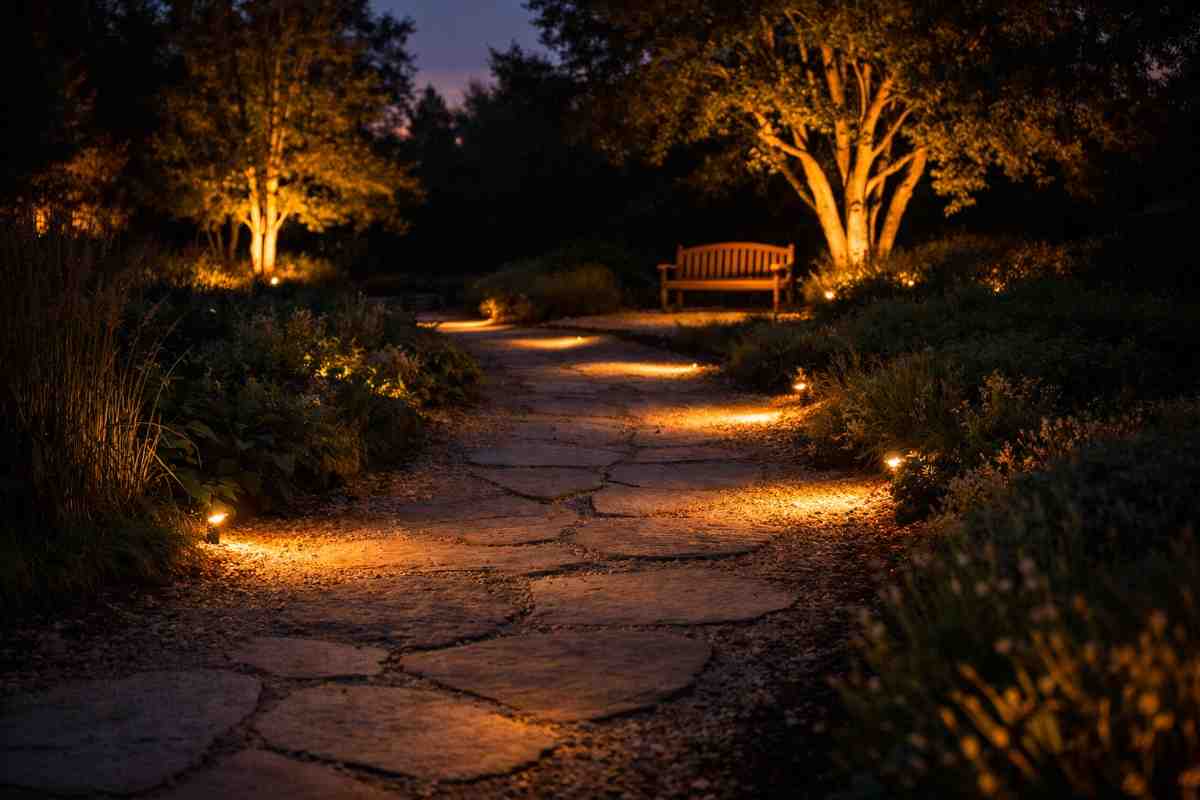
Spacing determines whether a path feels like a journey or a corridor.
This rhythm becomes most visible when spacing is experienced visually rather than described.
| Spacing | Effect | Walking Experience |
|---|---|---|
| 4-6 feet | Continuous guidance | Fast, confident, almost subconscious. The path pulls you forward without interruption. |
| 6-8 feet | Gentle rhythm | Measured, comfortable, still intuitive. The body moves between pools of light like stepping stones. |
| 8-12 feet | Discrete pools | Contemplative, exploratory. Each pool is its own moment. The darkness between becomes part of the experience. |
| 12+ feet | Occasional accent | Dramatic, uncertain. The path disappears between lights. Best for short distances or decorative intent. |
Stand at the beginning of a path just after dusk. Watch how the lights lead you forward. The body shouldn’t hesitate. If it does, the spacing is wrong.
Height and Orientation
| Height | Effect | Best For |
|---|---|---|
| Ground-level (inground) | Light pools directly on surface | Modern gardens, clean aesthetics, minimal visual clutter |
| 6-12 inches | Light spreads across path | Naturalistic gardens, softer edges |
| 12-24 inches | Light illuminates path and surrounding plants | Wider paths, transitional spaces |
| Bollards (24-36 inches) | Light at human scale | Formal gardens, entrance sequences, civic feeling |
Orientation matters more than height. Lights should direct light down and across the path surface, not out toward the garden. The goal is guidance, not landscape illumination. Trees and shrubs have their own lights for that.
→ Shop Solar Step Lights for Path Edges
The Hierarchy of Garden Light
With all four axes now defined, the complete spatial model emerges:
The 4-Axis Spatial Model:
- X (Fire Pit Tables): Horizontal gravity — social convergence. Warm, flickering, central.
- Y (Tree Uplighting): Vertical gravity — perception hierarchy. Directed upward, shadow-creating.
- Z (Pathway Lighting): Directional gravity — movement logic. Pools on ground, rhythm-based.
- A (Pathway Moonlighting): Ambient gravity — atmospheric mood. Soft, diffuse, from above.
Together, they form a complete spatial operating system for outdoor experience design.
For the complete guide to fire as horizontal gravity, see Fire Pit Tables. For trees as vertical gravity, see Hidden Uplighting for Mature Trees. For moonlighting as ambient gravity, see Garden Pathway Moonlighting.
What Happens at the Threshold
Step from the patio onto the path. The fire pit’s glow is behind you now. The trees stand in silhouette ahead.
The first pool of light appears at your feet. Then another, six feet ahead. Then another. You don’t think about walking. You just walk. The light pulls you forward as naturally as gravity pulls water downhill.
This is the threshold where movement architecture succeeds: when the garden stops requiring decisions. Your body knows where to go because the light has already decided for you.
Common Mistakes to Avoid
- Over-lighting — a path that glows like a runway feels institutional, not residential
- Glare from fixtures — if you see the bulb, the light is failing. Shield everything.
- Inconsistent spacing — the body craves rhythm. Random spacing creates hesitation.
- Ignoring destination — the path should end somewhere worth arriving at. Light the destination more brightly than the path.
- Cool white temperature — warm white (2700K-3000K) feels natural. Cool white feels like an airport.
Installation Quick Start
- Walk the path at night with a flashlight. Notice where your foot hesitates. Those are the light placement points.
- Space lights 6-8 feet apart for gentle rhythm, 4-6 feet for continuous guidance.
- Aim fixtures downward at a 30-45 degree angle across the path surface.
- Ensure the solar panel faces south (Northern Hemisphere) or north (Southern Hemisphere).
- Walk the path again. Adjust spacing and angle until movement feels unconscious.
Maintenance
- Clean solar panels monthly — dust reduces guidance clarity
- Trim vegetation that may spill light across the path
- Adjust angles seasonally as growth patterns change
- Replace fixtures when the rhythm breaks
Frequently Asked Questions
How far apart should pathway lights be spaced?
Generally 6-8 feet for continuous guidance, 10-15 feet for accent only. The rhythm of spacing determines whether the path reads as a single continuous line or a series of discrete pools of light.
Should pathway lights face up or down?
Downward-facing fixtures create pools of light on the walking surface. Upward-facing creates silhouettes and drama but offers less guidance. Most movement architecture relies on downward orientation for safety and directional clarity.
Do pathway lights need to be on both sides?
Single-sided alternating creates rhythm and asymmetry. Double-sided creates formality and enclosure. The choice shapes how the path feels: casual versus ceremonial.
What’s the ideal brightness for pathway lighting?
Just enough to see the surface texture. Over-lit paths feel like runways, not gardens. Under-lit paths feel uncertain. The target is comfortable navigation without conscious effort.
What is the difference between ground-level path lighting and moonlighting?
Ground-level path lighting uses fixtures at or below the walking surface to guide movement rhythm. Moonlighting uses downlighting from above (trees, structures) to create atmospheric mood. One is directional gravity (Z-axis); the other is ambient gravity (A-axis).
For homeowners building complete outdoor spatial systems, our articles on Fire Pit Tables, Tree Uplighting, and Pathway Moonlighting complete the full ecosystem of gathering (X), perception (Y), circulation (Z), and atmosphere (A).
The finest gardens are those that guide without instructing.
The Bottom Line
Pathway lighting is not about fixtures. It’s about rhythm. Space lights 6-8 feet apart for gentle guidance. Aim down, not out. Use warm white. Walk the path at night and adjust until movement feels unconscious.
A path during the day announces itself. A path at night reveals itself — step by step, pool by pool, until the garden has led you exactly where it wants you to go.
Plan the Whole Nightscape, Not Just the Path
If you are deciding where path lights should sit and what they should do, the Veluce Outdoor Lighting Blueprint takes the same principle further — audit the garden after dark, define priority zones, choose the effect first, then decide on fixtures.
Explore More
Browse the VELUCE shop → VELUCE Collection
Save ideas for later → VELUCE on Pinterest
Check the view from the people using it
Before adding brightness, use the outdoor lighting glare night audit to check exposed sources from seating, both walking directions and indoor windows. It helps separate aiming, shielding and reflection problems from a genuine need for more light.