Smart Access Control: When the Key Disappears
Some links may earn Veluce a commission at no extra cost to you. Purchases, delivery and returns are handled by the retailer. Affiliate disclosure.
Quick Takeaways
- The finest entry system is the one you never think about — no fumbling, no lost keys, no locked out moments
- Biometric recognition (fingerprint, face) eliminates the need to carry or remember anything
- Remote guest access allows temporary codes that expire automatically
- Smart locks are more secure than traditional locks (no picking, no bumping)
- Integration with lighting and climate creates seamless arrival and departure experiences
- Battery backups and warnings ensure you’re never stranded
The Philosophy of Frictionless Entry
The front door is the most touched surface in any home. Every arrival, every departure, every guest, every delivery — all of it passes through this single point of physical interaction. And for most of human history, that interaction required a small piece of metal: the key.
Keys are lost. Keys are copied. Keys are fumbled for in the dark while holding groceries. Keys announce their absence at the worst possible moments.
The finest homes are not defined by the technology they display,
but by the technology they allow you to forget.
Smart access control eliminates the key entirely. Not by replacing it with something equally fussy — a keypad you must memorize, an app you must open — but by making the authentication invisible. Your fingerprint. Your face. Your phone in your pocket, communicating silently with the lock before your hand touches the handle.
The goal is not more technology at the door. The goal is less friction. The door should welcome, not resist.
Decide What Kind of Entry You Want
Before selecting specific hardware, answer one question: How do you want arriving home to feel?
Choose biometric (fingerprint or facial recognition) if:
- You want to carry nothing and remember nothing
- Seamlessness matters more than budget
- Multiple family members need access without managing codes
Choose keypad entry if:
- You prefer a simpler, more affordable system
- You want the ability to give out temporary codes
- Biometric feels unnecessary for your use case
Choose smartphone-based entry if:
- You always have your phone on you
- You want integration with broader home automation
- Remote management is a priority
No single solution fits every door. The front door may warrant biometric. The side gate may only need a keypad. The garage may integrate with your vehicle. The best system is the one that matches how you actually live.
The Layered Luxury Model (What Most Homes Actually Do)
The most thoughtful approach is rarely pure visibility or pure concealment. It is a layered strategy that acknowledges different zones of the property serve different psychological purposes.
Perimeter (gates, driveway entrances, side approaches): Visible cameras and access controls deter casual intrusion before anyone reaches the house. This is not a design compromise — it is a psychological threshold.
House exterior (front door, back door, garage entry): Discreet integration into light fixtures, architectural recesses, or the locks themselves. Protection without visual tension.
Interior (entry hall, main living areas): Invisible or near-invisible. The home should feel like a sanctuary, not a facility.
This layered model — visible at the perimeter, invisible at the house — is the default for luxury properties. It resolves the false choice between security and aesthetics.
Biometric Recognition: You Are the Key
Biometric systems have matured dramatically in recent years. What once required a deliberate press-and-hold now happens in milliseconds, often before you consciously reach for the handle.
Fingerprint recognition: The most common biometric for door locks. Modern optical and capacitive sensors work in rain, cold, and with slightly dirty fingers. Registration takes seconds. Recognition is near-instant.
The biometric advantage: You cannot lose your fingerprint. You cannot forget it. And unlike a traditional key, your fingerprint cannot be easily duplicated without sophisticated methods. It works the same way at 2 PM and 2 AM.
The biometric consideration: Sensor quality varies dramatically. Inexpensive sensors can be fooled. Invest in established brands with proven optical or capacitive technology.
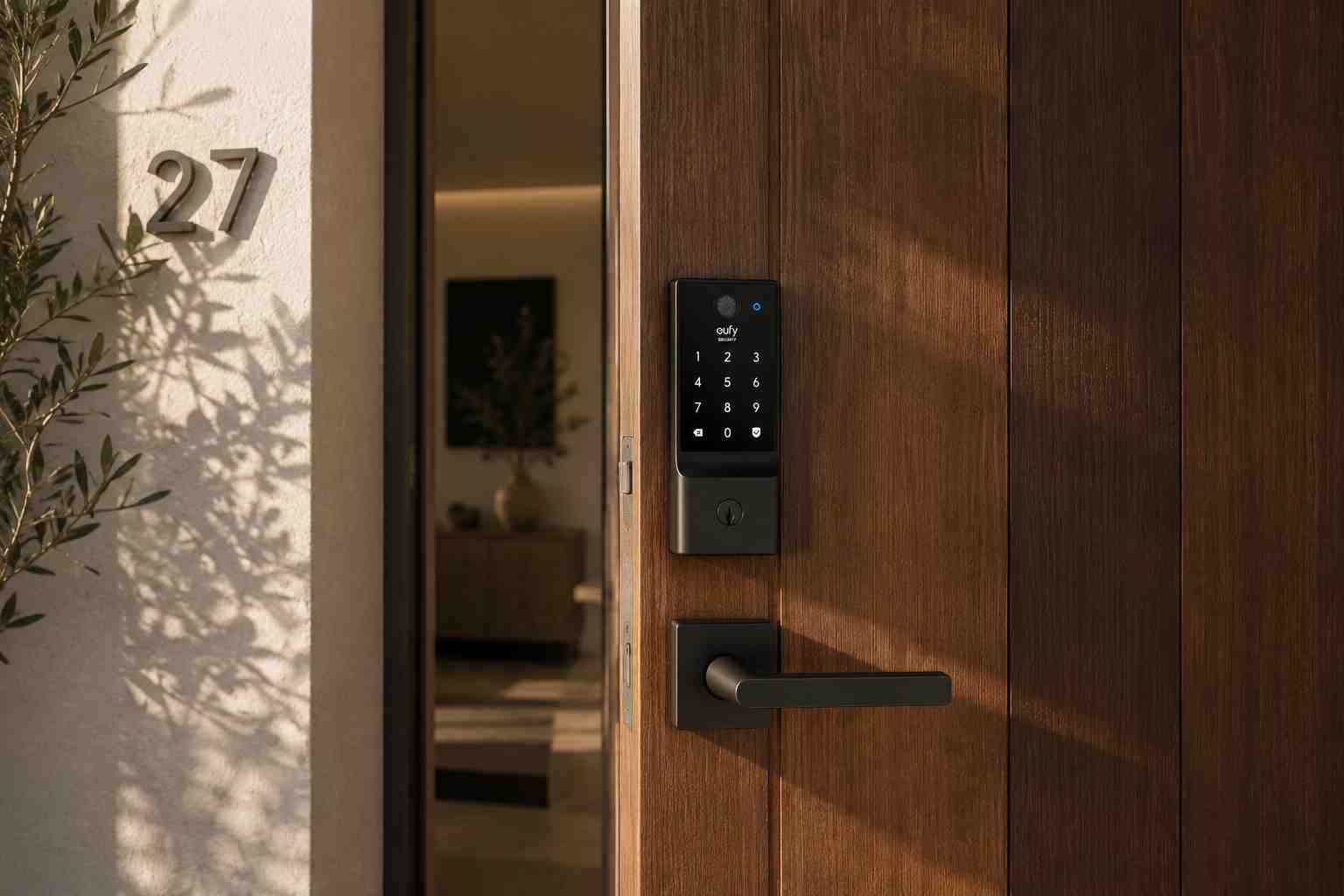
For those seeking a biometric system that requires no hub and no monthly fees, the eufy Security Smart Lock C220 offers self-learning AI fingerprint recognition that improves with each use. Built-in Wi-Fi enables remote control from anywhere, with six ways to unlock providing redundancy.
Keypad + Biometric + Wi-Fi: The Complete Package
When a lock combines keypad access with biometric fingerprint scanning and built-in Wi-Fi, it gains the flexibility to serve everyone in the household — family members who prefer the fingerprint scanner, guests who need a temporary code, and remote management from anywhere.
The advantages:
- No physical key to lose or copy
- Fingerprint scan or code — two seamless options
- Temporary codes that expire automatically
- Remote locking and unlocking via app
- Activity logs show who entered and when
Best for: Primary front door entry where multiple users want different unlock methods.
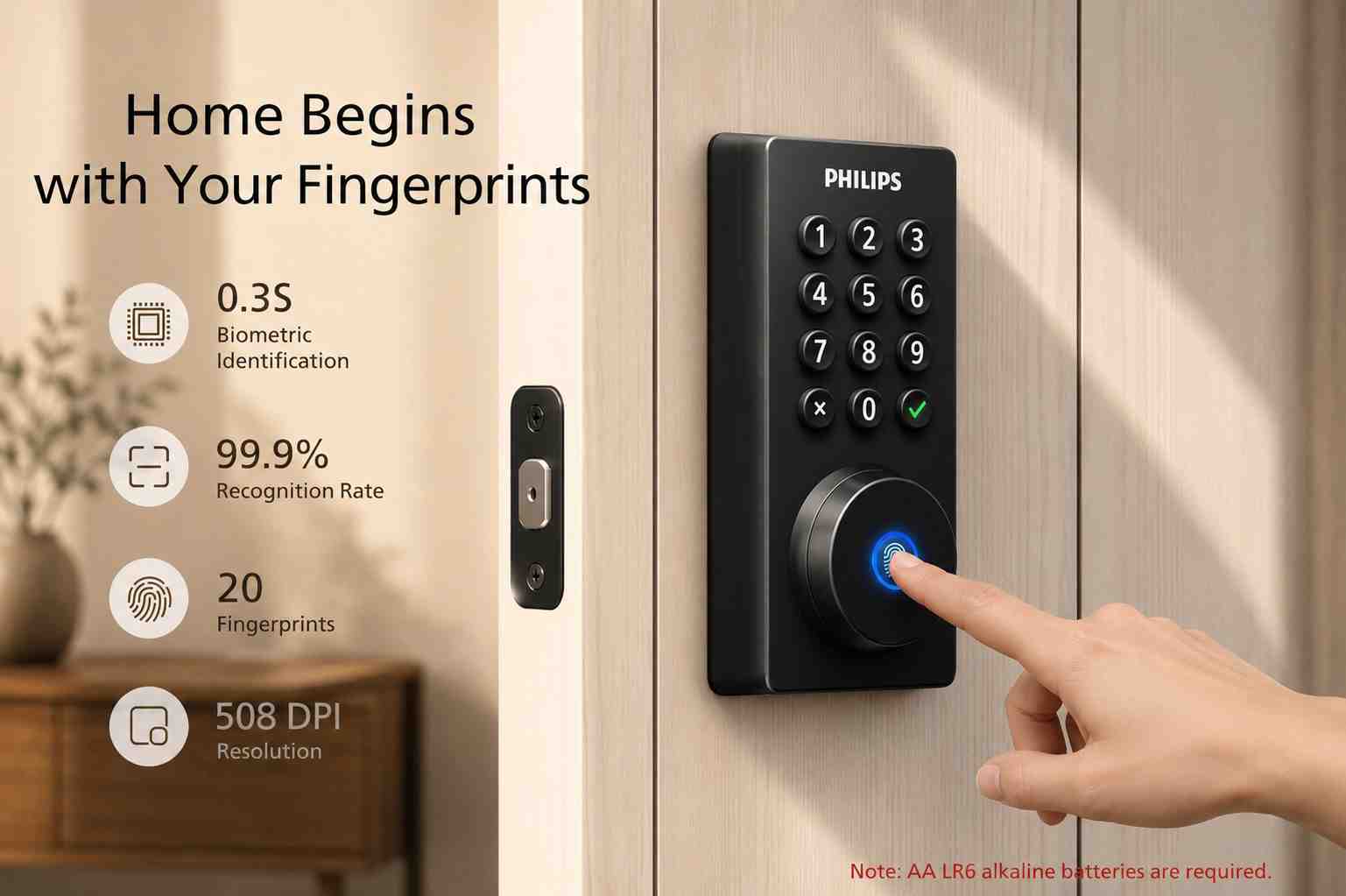
Home begins with your fingerprints. The Philips Wi-Fi Smart Lock combines a backlit keypad with a circular fingerprint scanner (0.3-second identification, 99.9% recognition rate, storage for 20 fingerprints). Built-in Wi-Fi enables remote access management, and the system operates on standard AA alkaline batteries.
Remote Guest Access: The Key You Send Digitally
This is where smart access fundamentally outperforms traditional locks. A physical key, once given, cannot be revoked without changing the lock. A digital key or temporary code can be created, scheduled, and destroyed remotely.
Use cases:
- A houseguest arriving while you’re still at work
- A dog walker who needs access only on specific days and times
- A contractor working on a renovation who needs access only during business hours
How it works: Most systems allow you to generate time-limited codes or digital keys. The code works only between Wednesday at 10 AM and Friday at 5 PM. After that, it simply stops working. No key to retrieve. No lock to rekey.
Security note: Every code is logged. You can see who entered and when. This alone is a significant upgrade from traditional keys, which leave no audit trail.
Two products for a layered entry system
For many homes, the most useful combination is a smart lock at the door and a separate visual-verification layer at the approach. Treat both as parts of the access system rather than isolated gadgets.
- → Browse the fingerprint/keypad smart lock — check door thickness, backset, handing, lock-body dimensions, battery access, and app compatibility before ordering.
- → Browse the smart video doorbell — useful for visual confirmation and guest arrival; verify current power, Wi-Fi, chime, and storage requirements.
Integration: Arrival as an Event
Smart access becomes truly powerful when integrated with other home systems. The door unlocking should not happen in isolation. It should trigger a sequence.
Arriving home:
- Door unlocks as you approach
- Entryway lights turn on (at a welcoming warmth, not full brightness)
- HVAC adjusts from away mode to comfort temperature
- Shades in the entry area raise
- Security system disarms
Departing home:
- Door locks behind you
- All lights turn off after a delay
- HVAC shifts to away mode
- Shades lower
- Security system arms
This is not automation for automation’s sake. This is the home adapting to the rhythms of the people within it — without requiring anyone to press a sequence of buttons or open an app.
Edge Conditions of Architecture
Beyond primary architectural features (light fixtures, soffits, eaves), standard utility elements offer additional opportunities for integration. These are not the first choice — but when a corner needs coverage and no elegant solution exists, they solve the problem.
Downspouts: A camera or sensor integrated into a downspout at the corner of a house can overlook driveways or side approaches. The downspout already exists. The technology lives inside it.
Ventilation grilles: Existing exhaust vents or fresh-air intakes can be modified to accommodate small housings. The grille provides natural concealment.
Service structures: Electrical meter boxes, irrigation controllers, and other utility enclosures can be replaced with modified versions containing integrated technology.
Best for: Perimeter corners, driveway monitoring, side-yard coverage where architectural features are sparse. These are honest solutions — they do not pretend to be something they are not.
Security Considerations (Addressed)
Encryption: Quality smart locks encrypt all wireless communication. Without encryption, someone with technical knowledge could intercept and replay your unlock signal.
Battery backup: Most smart locks are battery-powered. Quality systems provide months of operation and warn you well before depletion. Backup options include emergency codes, physical keys, or external USB charging.
Lockpicking: Traditional locks are vulnerable to picking and bumping. Smart locks typically are not — they have no physical keyway to manipulate. For physical security, smart locks are generally superior.
The real vulnerability: User behavior. Sharing codes too widely. Choosing predictable PINs like 1234 or birth years. Not updating firmware.
Battery Life and Power Failures
Smart locks run on batteries intentionally — they continue working during power outages. Quality systems provide:
- 6-12 months of battery life for frequent use
- Low-battery warnings weeks before depletion
- Backup key or USB charging for emergencies
What to check before buying: Can you unlock from the inside without batteries? (Most can — a simple mechanical turn.) Can you charge externally if batteries die while you’re outside? (Some offer USB ports on the exterior.)
Common Mistakes in Smart Access
- Buying the cheapest option available — Inexpensive smart locks have poor sensors, weak encryption, and unreliable apps.
- Forgetting to change default codes — Many systems ship with default admin codes. Change them immediately.
- No backup entry method — Batteries die. Phones die. Always have a backup.
- Ignoring firmware updates — Security vulnerabilities are discovered and patched. Your lock needs updates just like your phone.
- Sharing codes too widely — Every person with a code is a potential vulnerability. Use temporary codes for guests.
- Choosing a lock that doesn’t fit your door — Measure before buying.
Decision Framework: Which System for Which Door?
Front door: Biometric + keypad backup + smartphone integration. This is the primary entry. Invest accordingly.
Back door / mudroom entry: Keypad or smartphone-only. Used less frequently, but still needs reliable access.
Garage entry: Keypad or smartphone. Often integrated with garage door opener rather than a separate lock.
Side gate: Keypad only. Exposed to weather. Simple and durable matters more than advanced features.
Interior doors (study, wine cellar): Biometric or keypad depending on security requirements. Interior smart locks are often simpler.
Guest house or rental unit: Keypad with robust temporary code management.
The Bottom Line
The physical key is a relic. It can be lost. It can be copied. It provides no record of who came and went. It forces you to be physically present to grant access.
Smart access control eliminates every one of these limitations. Biometric systems make you the key — nothing to carry, nothing to remember. Remote access lets you grant entry from anywhere in the world. Integration with lighting and climate turns arrival from a chore into a welcome.
The finest homes are not defined by the technology they display,
but by the technology they allow you to forget.
The key, forgotten in a drawer somewhere, is the ultimate proof that the system worked.
Explore More from VELUCE
Frequently Asked Questions
Are smart locks secure?
Yes. Modern smart locks employ encryption and multi-factor authentication. They are generally more secure than traditional locks because they cannot be picked or bumped. The primary vulnerability is user behavior — sharing codes too widely or choosing predictable PINs.
What happens if the battery dies?
Most smart locks provide weeks or months of battery life and warn you well before depletion. Backup options include emergency codes, physical keys, or external USB charging. A quality system will never leave you stranded without warning.
Can I use smart locks on all my doors?
Yes. Front doors, back doors, garage entry doors, and even interior doors (studies, wine cellars, gun rooms) can be equipped with smart access. Different form factors serve different door types.
What’s the difference between biometric and keypad systems?
Biometric systems (fingerprint, facial recognition) require nothing carried or remembered — you are the key. Keypad systems require a code. Biometrics are more seamless but typically more expensive. Both are more secure than physical keys.
Can I grant temporary access to guests?
Yes. Most smart access systems allow you to generate time-limited codes or digital keys that expire automatically. This is one of the primary advantages over traditional locks — no key copying, no retrieving keys after a guest leaves.
Do smart locks work during a power outage?
Most smart locks are battery-powered and continue operating normally during power outages. Hardwired systems typically include battery backups. Check specifications before purchasing.
Can smart locks integrate with my other home systems?
Yes. Access events can trigger lighting, climate adjustments, or security system changes. Arriving home can activate welcome lighting. Departure can arm the security system and lower shades. This is where smart access becomes truly seamless.
Make the Buying Decision More Deliberate
Smart locks are not just a style choice — compatibility, power, access methods, backup options, integrations and seller claims all need to be checked before purchase. The Veluce Room Procurement System gives you a structured way to compare options, verify constraints and keep the evidence in one place before you commit.
Explore More
Browse the VELUCE shop → VELUCE Collection
Save ideas for later → VELUCE on Pinterest