Natural Stone: Travertine, Marble, and Limestone Compared
Some links may earn Veluce a commission at no extra cost to you. Purchases, delivery and returns are handled by the retailer. Affiliate disclosure.
Quick Takeaways
- Marble offers dramatic veining and luminosity but requires careful maintenance
- Travertine brings architectural warmth and hides daily wear better than polished marble
- Limestone provides subtle elegance and works beautifully in contemporary spaces
- All three stones need regular sealing — frequency varies by type and use
- Each stone suits different applications: marble for statements, travertine for flooring, limestone for versatility
Why Natural Stone Endures
Few materials communicate permanence and refinement as effectively as natural stone. From ancient Roman temples to contemporary luxury homes, stone has been the material of choice for architecture designed to endure for centuries.
Unlike manufactured surfaces that degrade and date, natural stone gains character over time. Each scratch, patina, and mineral variation tells a story. The finest materials do not simply endure — they become more compelling with time.
Three stones dominate luxury interior design: marble, travertine, and limestone. Each offers distinct beauty, performance characteristics, and maintenance requirements. Understanding the differences ensures you choose the right stone for the right application — a philosophy at the heart of the VELUCE approach.
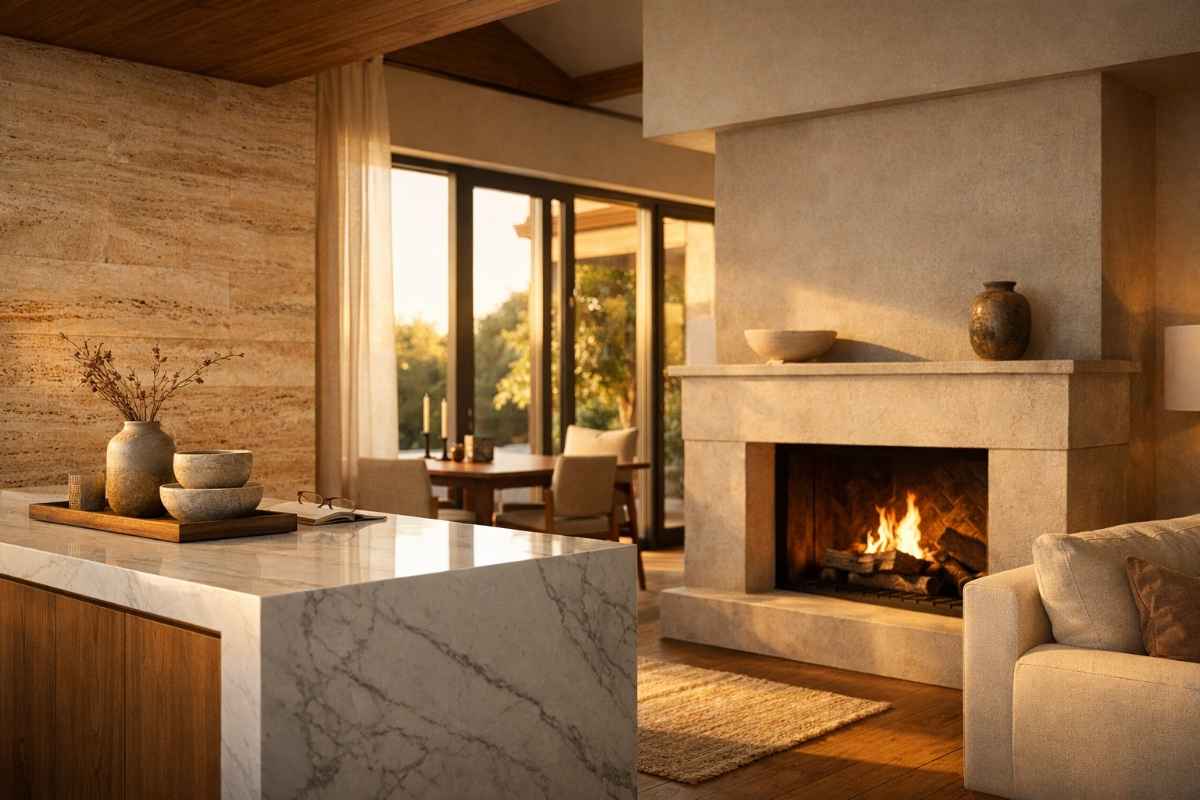
Marble: The Benchmark of Luxury
For centuries, marble has been synonymous with architectural prestige. Prized in palaces, temples, and the world’s most celebrated homes, marble brings an unmatched luminosity and veining pattern that cannot be replicated. It has long been the benchmark against which luxury materials are measured.
Popular varieties:
- Carrara (Italy): Classic white with subtle, soft gray veining
- Calacatta (Italy): Bold, dramatic veining on bright white background
- Statuario (Italy): Bright white with distinctive gray veining
- Nero Marquina (Spain): Deep black with white veining
Strengths:
- Unmatched luminosity and veining patterns
- Each slab is unique — a true work of nature
- Takes a high polish for reflective surfaces
- Ideal for carving and sculptural details
Considerations:
- Soft and susceptible to scratching
- Etches when exposed to acidic substances (lemon, vinegar, wine)
- Requires regular sealing (every 1-2 years)
- Polished finishes show wear more readily
Best applications:
- Bathroom vanities (lower acid exposure than kitchens)
- Fireplace surrounds (dramatic focal points)
- Accent walls (where beauty can be showcased)
- Low-traffic countertops (pastry stations, bars)
Stone feature walls and fireplaces become particularly striking when paired with carefully considered upward lighting.
Travertine: Architectural Warmth
Travertine brings an architectural warmth that has defined Mediterranean villas for centuries. Its warm earth tones and distinctive pitted surfaces create a textured, lived-in elegance that polished stones cannot match.
Technical note: Travertine is a form of limestone deposited by mineral springs. While it is calcium carbonate-based and can etch from acids, its textured and matte finishes often make etching and daily wear far less noticeable than on polished marble. This is why many designers consider it more “forgiving” in busy homes.
Popular finishes:
- Tumbled: Soft, aged appearance with rounded edges
- Brushed: Textured, slightly weathered look
- Honed: Matte, smooth finish without gloss
- Polished: Glossy finish (less common for travertine)
Strengths:
- Textured finishes hide daily wear effectively
- Warm, natural color palette (cream, beige, walnut, gold)
- Excellent for flooring and high-traffic areas
- More forgiving of maintenance lapses than marble
Considerations:
- Requires sealing to prevent staining
- Natural pits and holes may need filler
- Can be cold underfoot without radiant heating
- Tumbled finishes collect dust in crevices
Best applications:
- Flooring (especially in entryways, kitchens, sunrooms)
- Wall cladding (interior and exterior)
- Outdoor kitchens (durable in covered applications)
- Bathroom floors (textured finishes provide grip)
Limestone: Subtle Elegance
Limestone balances sophistication with practicality, offering a more uniform appearance than travertine while feeling more forgiving than polished marble in everyday use. Its subtle color variations and fine grain create an understated elegance that works exceptionally well in contemporary interiors.
Popular varieties:
- Jura (Germany): Warm gray-beige with fossilized patterns
- Moleanos (Portugal): Uniform light beige, very consistent
- Cotswold (England): Soft cream with subtle variation
- Jerusalem (Israel): Golden-beige with fossil details
Strengths:
- Uniform appearance — less dramatic than marble
- More practical than polished marble for daily use
- Works in both traditional and contemporary settings
- Takes honed and matte finishes beautifully
Considerations:
- Still susceptible to acid etching
- Requires regular sealing
- Softer than granite or quartzite
- Limited color range (whites, beiges, grays)
Best applications:
- Fireplace surrounds (understated focal points)
- Bathroom vanities (elegant without drama)
- Flooring (especially in large-format tiles)
- Exterior cladding (where weather resistance matters)
What About Quartzite?
Homeowners who love the appearance of marble but want greater resistance to scratching and etching often discover quartzite. Quartzite is a natural metamorphic stone that forms from sandstone under heat and pressure. It offers marble-like veining and luminosity with hardness approaching granite.
Marble vs. Quartzite:
| Feature | Marble | Quartzite |
|---|---|---|
| Hardness | Softer, scratches more easily | Very hard, resists scratching |
| Etching resistance | Low (etches from acids) | High (very resistant) |
| Maintenance | Requires regular sealing | Less frequent sealing needed |
| Appearance | Soft, romantic veining | Crisp, dramatic veining |
| Price | $50-150+ per sq ft | $70-200+ per sq ft |
Quartzite is an excellent alternative for kitchen countertops and other high-use surfaces where marble’s beauty is desired but its maintenance requirements are a concern.
How to Choose the Right Natural Stone
Choose Marble If:
- You prioritize dramatic beauty over maintenance concerns
- You want distinctive veining as a design feature
- You’re designing a focal point (vanity, fireplace, accent wall)
- You accept that patina and character will develop over time
- The application is low-traffic (powder bath, primary suite)
Choose Travertine If:
- You want warmth and texture as primary design elements
- You need practical, durable flooring for busy areas
- You prefer Mediterranean, Tuscan, or transitional aesthetics
- You want a finish that hides daily wear and etching
- You’re willing to embrace natural pitting and variation
Choose Limestone If:
- You want subtle, understated luxury
- Your interior style is contemporary or minimalist
- You prefer visual consistency over dramatic variation
- The application requires a honed, matte finish
- You’re designing a fireplace surround or feature wall
Expert Insight: Before You Buy
Before purchasing any natural stone, request a full slab viewing rather than relying on a small sample. Veining, color variation, fossilization, and movement can differ dramatically across a slab. A 4-inch sample may show subtle gray veining while the full slab reveals bold, dramatic patterns — or vice versa. This single step prevents disappointment and ensures the stone you receive matches the stone you selected.
Comparison at a Glance
Marble:
- Surface hardness: High (but softer than granite)
- Etching visibility: Very visible on polished finishes
- Staining resistance: Low
- Sealing frequency: Every 1-2 years
- Color range: Whites, grays, blacks, greens, pinks
- Typical finish: Polished, honed
- Best for: Statement pieces
- Price point: Premium
Travertine:
- Surface hardness: Moderate
- Etching visibility: Less visible on textured finishes
- Staining resistance: Moderate
- Sealing frequency: Every 2-3 years
- Color range: Creams, beiges, walnuts, golds
- Typical finish: Tumbled, honed, brushed
- Best for: Flooring, walls
- Price point: Moderate
Limestone:
- Surface hardness: Moderate-High
- Etching visibility: Visible on polished, less on honed
- Staining resistance: Moderate
- Sealing frequency: Every 1-2 years
- Color range: Whites, beiges, grays
- Typical finish: Honed, polished
- Best for: Versatile applications
- Price point: Moderate-High
Application Guide
Kitchen countertops:
- Marble: ⚠️ Only for low-traffic or pastry stations
- Travertine: ✅ Best choice of the three — textured finishes hide wear
- Limestone: ⚠️ Acceptable with diligent sealing
- Quartzite: ✅ Excellent alternative for marble-lovers needing durability
Bathroom vanities:
- Marble: ✅ Excellent choice (lower acid exposure)
- Travertine: ✅ Works well — seal thoroughly around sinks
- Limestone: ✅ Beautiful option for contemporary spaces
Flooring:
- Marble: ⚠️ Shows wear — best for low-traffic areas
- Travertine: ✅ Excellent — textured finishes hide daily wear
- Limestone: ✅ Very good — best in large-format tiles
Fireplace surrounds:
- Marble: ✅ Dramatic and classic
- Travertine: ✅ Warm and inviting
- Limestone: ✅ Understated elegance for contemporary homes
Maintenance: Protecting Your Investment
General guidelines:
- Dust or sweep: Daily
- Damp mop with pH-neutral cleaner: Weekly
- Seal (impregnating sealer): Every 1-3 years depending on stone and use
- Avoid acidic cleaners: Never use vinegar, lemon, bleach, or ammonia
Marble tips:
- Use cutting boards and coasters — always
- Wipe spills immediately (wine, coffee, citrus, tomato)
- Consider honed finish for kitchens (shows etching less)
- Reapply sealer annually for high-use surfaces
Travertine tips:
- Fill natural pits if desired (unfilled is more authentic)
- Tumbled and brushed finishes are more forgiving of wear
- Seal before grouting to prevent staining
- Reapply sealer every 2-3 years
Limestone tips:
- Use placemats and trivets for hot dishes
- Honed finish is more practical than polished
- Clean with stone-specific pH-neutral products
- Reapply sealer every 1-2 years
A restrained stone-care kit
Stone lasts because the material is durable, not because it is maintenance-free. Keep the care kit simple and verify every chemical product against the specific stone and finish before use.
- → Browse soft microfiber cleaning cloths — a low-risk everyday cleaning tool for finished stone surfaces.
- → Browse the heat-resistant silicone trivet — useful where stone surfaces meet hot cookware.
- → Browse the stone-cleaner candidate — confirm the current label is appropriate for your stone, finish, and required pH before applying it.
The Honed vs Polished Distinction
Polished:
- Appearance: Glossy, reflective, dramatic
- Best for: Statement pieces, low-traffic areas
- Maintenance: Shows wear, etches visibly
Honed:
- Appearance: Matte, smooth, subtle
- Best for: Floors, countertops, high-traffic areas
- Maintenance: Hides wear and etching better
For most residential applications, honed finishes are more practical. They conceal the inevitable scratches and etching that come with daily life, while still showcasing the stone’s natural beauty.
Cost Considerations
Pricing varies significantly by region, stone availability, fabrication complexity, edge profile, and installation requirements.
- Marble: $50-150+ per square foot — premium for dramatic beauty
- Travertine: $15-40 per square foot — excellent value for durability
- Limestone: $25-60 per square foot — mid-range for understated elegance
All natural stone represents a long-term investment that appreciates in character over time. Unlike manufactured surfaces that date and discolor, natural stone grows more beautiful with age — and with proper care, outlasts every other material in your home.
Frequently Asked Questions
Which natural stone is best for kitchen countertops?
Travertine offers better durability and is more forgiving than marble, but neither matches granite or quartzite for kitchen use. For homeowners who love marble’s appearance but want greater resistance to scratching and etching, quartzite is a compelling alternative.
How often should I seal natural stone?
Marble and limestone typically need sealing every 1-2 years. Travertine can go 2-3 years between sealings, though high-use areas may need more frequent attention. Always use a high-quality impregnating sealer designed for natural stone.
Can I use natural stone in bathrooms?
Yes. All three stones work beautifully in bathrooms, but proper sealing and ventilation are essential. Travertine’s porosity requires more careful moisture management. Honed finishes are less slippery than polished for wet areas.
What’s the difference between honed and polished stone?
Polished stone has a glossy, reflective finish that enhances color and veining but shows scratches and etching more easily. Honed stone has a matte, satin finish that is more forgiving of wear and better suited for floors and high-traffic areas.
Is natural stone better than porcelain?
Each has advantages. Natural stone offers unique veining, patina development, and timeless authenticity that cannot be replicated. Porcelain offers greater stain resistance and requires less maintenance. The choice depends on whether you prioritize authentic character or practical convenience.
Does marble stain permanently?
Marble is porous and can absorb liquids that cause stains, but many stains can be removed with a poultice. Sealing significantly reduces staining risk. For peace of mind, honed marble hides incidental staining better than polished.
Which stone is most durable?
Of these three, travertine generally offers better resistance to daily wear and its textured finishes make scratches less visible. However, for absolute durability in kitchens, granite and quartzite outperform all three.
For homeowners drawn to timeless materials, our article on Copper Lanterns That Age With Grace explores another approach to selecting materials that improve with age.
The finest materials do not simply endure — they become more compelling with time.
The Bottom Line
Choose marble when you want drama — for bathroom vanities, fireplace surrounds, and statement pieces where beauty outweighs maintenance concerns.
Choose travertine when you want warmth and practicality — for flooring, wall cladding, and high-traffic areas that need to perform while hiding daily wear.
Choose limestone when you want understated elegance — for contemporary spaces, fireplace surrounds, and applications where visual consistency matters.
All three are genuine luxury materials. The right choice depends not on which is “best” in absolute terms, but on which best suits your home, your lifestyle, and your tolerance for maintenance.
The most memorable luxury interiors combine timeless materials with thoughtful illumination. Stone, copper, timber, and architectural lighting each gain character with age, creating homes that feel richer year after year.
These materials have endured for millennia. With proper care, they can remain beautiful for generations.
Take the Material Choice into the Buying Stage
Once you have narrowed the look to marble, travertine or limestone, the next risk is buying the wrong slab, finish or specification for the way the space will actually be used. The Veluce Room Procurement System helps you compare product evidence, maintenance needs, dimensions, seller claims and installation constraints before you commit.
Explore More
Browse the VELUCE shop → VELUCE Collection
Save ideas for later → VELUCE on Pinterest