Moonlighting Trees: How to Create Natural Moonlight in the Garden
Some links may earn Veluce a commission at no extra cost to you. Purchases, delivery and returns are handled by the retailer. Affiliate disclosure.
Quick Takeaways
- Moonlighting mimics natural moonlight filtering through tree canopies from above
- Fixtures should be mounted 15-25 feet high, aimed downward at a steep angle
- Warm white (2700K) creates the most natural, romantic atmosphere
- Trees with open branching patterns create the best dappled shadow effects
- Moonlighting works beautifully alongside uplighting for layered illumination
Light That Falls Like Moonlight
Natural moonlight doesn’t announce itself. It arrives softly, indirectly, creating atmosphere without demanding attention. The garden reveals itself gradually — a branch here, a curve there — never all at once.
In moonlighting landscape lighting, fixtures are concealed high above the garden so the effect resembles natural moonlight filtering through branches. The result is not illumination — it’s atmosphere.
*This scene combines uplighting to reveal the trunk's texture with moonlighting (downlighting from the canopy) to create dappled shadows on the ground — a layered approach to tree illumination.*
What Is Moonlighting?
Moonlighting is the technique of positioning light sources above the landscape — typically in tree canopies, under eaves, or on structures — and directing soft, diffuse light downward. The effect mimics natural moonlight: gentle, shadowed, and atmospheric.
Unlike uplighting (which reveals vertical structure from below), moonlighting creates dappled shadows on the ground and soft illumination across surfaces. The light source remains invisible. Only the effect exists.
This technique works best in gardens designed for wandering rather than efficient navigation. Woodland walks. Winding paths beneath mature trees. Transitional spaces between garden rooms.
Moonlighting vs. Uplighting: Different Roles
| Technique | Light Origin | Effect | Best For |
|---|---|---|---|
| Moonlighting | From above (tree canopies, structures) | Dappled shadows, soft ground illumination | Creating atmosphere, woodland walks |
| Uplighting | From ground, aimed upward | Dramatic shadow, vertical emphasis | Revealing trunk texture, canopy structure |
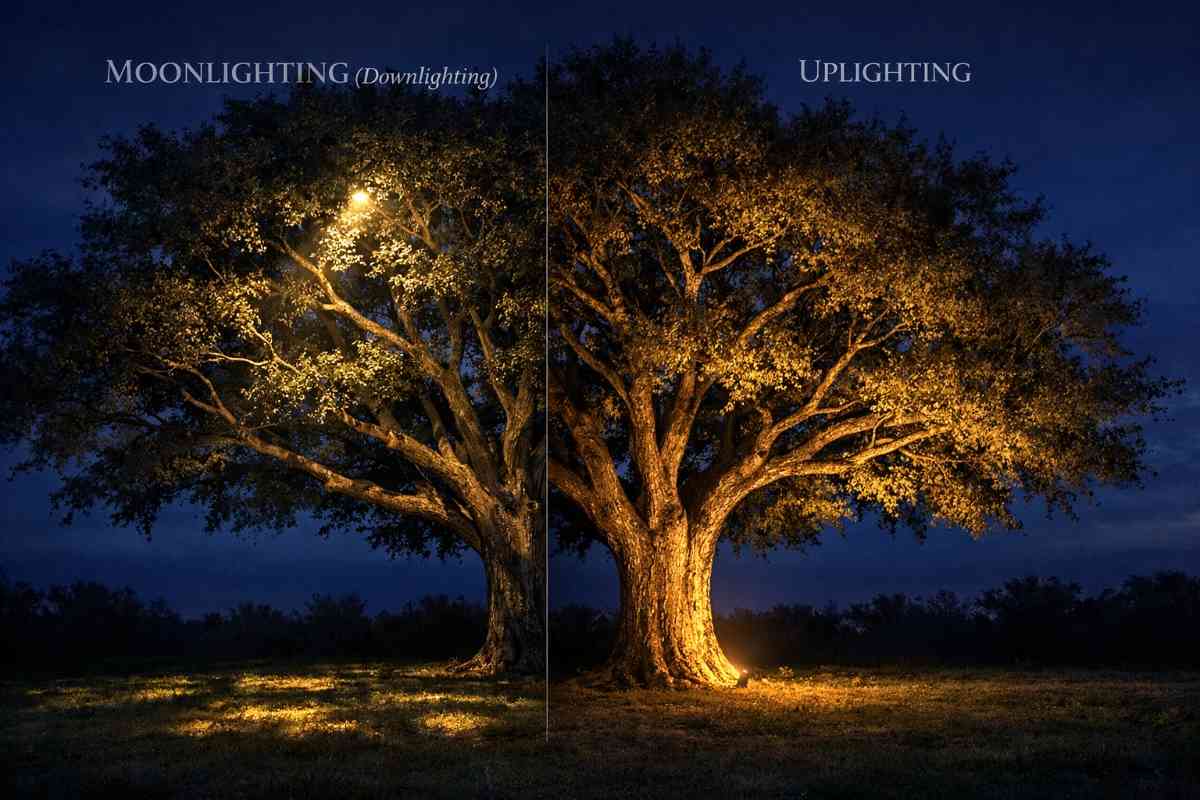
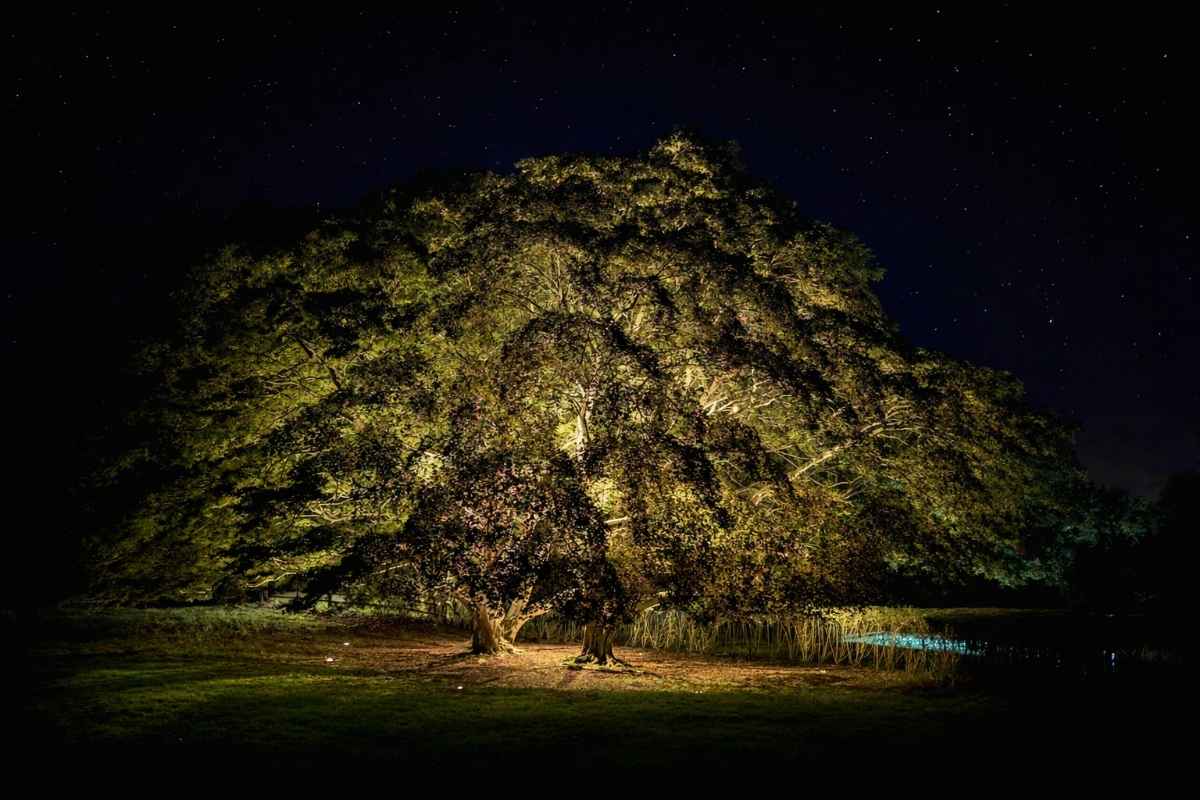
Used together, they create a complete tree illumination system — uplighting reveals the trunk and lower canopy, while moonlighting casts soft light downward through the branches. This layered approach is what you see in the hero image above.
→ Shop Narrow-Beam Spotlights for Tree Lighting
Note: Wired fixtures remain the preferred option for permanent moonlighting installations, while solar spotlights can work effectively in lower-access applications or where wiring is impractical.
Where Moonlighting Excels
| Setting | Why It Works |
|---|---|
| Woodland walks | Light filtering through branches feels organic and magical |
| Winding garden paths | Soft, dappled shadows create a sense of discovery |
| Between garden rooms | Creates transition without harsh direction |
| Seating areas beneath trees | Ambient glow without glare or visible fixtures |
| Specimen trees | Highlights the tree’s branching structure naturally |
Fixture Placement: The Invisible Rule
The most important rule of moonlighting is simple: never see the fixture.
Mount lights 15-25 feet above ground level, positioned within the tree canopy or on overhead structures. The goal is to have the light source completely concealed by branches, leaves, or architectural elements.
If you can see the light source from the path, the magic is lost. The garden should feel moonlit, not floodlit.
For trees, this often means mounting fixtures to sturdy branches, aiming downward at a 60-75 degree angle from horizontal. Use non-invasive mounting straps or brackets (no drilling into healthy trees). Consult a qualified installer for large trees or installations requiring work at height.
Spacing and Beam Angle
| Beam Angle | Effect | Best For |
|---|---|---|
| 25-40 degrees (narrow to medium) | Defined dappled shadows, dramatic effect | Specimen trees, creating contrast |
| 40-60 degrees (wide) | Softer, more diffuse illumination | Dense canopies, broader coverage |
| 60+ degrees (very wide) | Gentle wash, minimal shadow | Large areas, subtle effect |
For most moonlighting applications, narrow to medium beam angles work best. They concentrate light where needed while creating the distinct shadow patterns that define the technique.
Color Temperature: Warmth Is Atmosphere
| Temperature | Effect | Best For |
|---|---|---|
| 2700K (warm white) | Natural, moonlike softness | Most gardens, romantic atmosphere |
| 3000K (soft white) | Slightly structured warmth | Mixed-use areas |
| 4000K+ (cool white) | Breaks atmospheric realism | Avoid — ruins the moonlight effect |
While actual moonlight is reflected sunlight, warmer color temperatures tend to create the emotional softness people associate with moonlit gardens. For most residential landscapes, 2700K delivers the most inviting interpretation of the effect.
Trees That Work Best for Moonlighting
| Tree Type | Shadow Pattern | Best For |
|---|---|---|
| Japanese maple | Fine, lacy, intricate | Intimate gardens, detailed shadow play |
| Birch | Delicate, dappled | Woodland settings, bright bark contrast |
| Crabapple | Moderate, rounded | Spring interest + summer canopy |
| Oak | Bold, dramatic | Large landscapes, strong architecture |
| Beech | Dense, soft | Privacy screens, filtered light |
Trees with open branching patterns create the most beautiful shadow effects. Dense, solid canopies block light entirely — better suited for uplighting alone.
Deciduous trees transform dramatically throughout the seasons. The intricate shadows of summer often become bolder and more graphic once leaves fall, requiring occasional fixture adjustments.
Building a wired low-voltage moonlighting layer
For a permanent system, low-voltage wiring gives you consistent output and avoids relying on a solar panel positioned high in or near the canopy. The light source still needs to disappear visually, and any tree attachment should use a suitable non-invasive mounting method.
- → Browse the 12V directional landscape/tree spotlight — a candidate for directional lighting where the mounting arrangement suits the tree and desired beam.
- → Browse the 220V-to-12V/24V outdoor transformer — for converting the supply to low voltage before the landscape circuit.
- → Browse IP68 low-voltage connectors — for weather-protected joins on the low-voltage side.
Layering Moonlighting with Other Garden Lights
Moonlighting works best as part of a complete lighting system:
- Canopy (Moonlighting): Creates dappled shadows, atmosphere — fixed, natural-direction fixtures
- Trunk (Uplighting): Reveals texture, vertical structure — adjustable spotlights
- Paths (Ground-level lighting): Guides movement safely — inground or low-profile markers
- Edges (Accent lighting): Defines garden boundaries — linear LED strips
For a complete guide to uplighting trees, see Hidden Uplighting for Mature Trees. For pathway lighting, see Garden Pathway Lighting.
Explore the complete VELUCE outdoor lighting collection →
What Happens at Dusk
The sun sets. The garden darkens. Then, slowly, the canopy begins to glow.
Light filters down through branches, not from below. The source remains invisible — hidden in the tree, tucked into the architecture. Only the effect remains: dappled pools of light on the grass, soft shadows that shift with every breeze.
This is the magic of moonlighting: not illumination, but atmosphere. The garden doesn’t become visible — it becomes legible. Revealed gradually, as if by moonlight.
Common Mistakes to Avoid
- Visible fixtures — if you see the light source, the moonlight illusion fails
- Cool white temperature — ruins the natural, warm effect
- Too bright — moonlight is subtle. Over-lit trees feel artificial
- Mounting too low — creates glare and reveals fixtures
- Ignoring seasonal changes — deciduous trees lose leaves; the same fixture may look harsh in winter
- Using only moonlighting without uplighting — the trunk disappears into darkness; combine both for complete effect
Installation Quick Start
- Identify sturdy branches or overhead structures 15-25 feet above ground
- Choose warm white (2700K) fixtures with 25-40 degree beam spread
- Use non-invasive mounting straps or brackets (no drilling into healthy trees). Consult a qualified installer for large trees or installations requiring work at height.
- Aim fixtures downward at a 60-75 degree angle through the canopy
- Test at night — adjust angles until the source is invisible
- The canopy should glow. The fixtures should not.
Maintenance
- Clean lenses annually — dust reduces the soft, diffuse effect
- Inspect mounting hardware — trees grow and shift over time
- Trim branches that may block or redirect light
- Adjust angles seasonally as canopies change
- Replace bulbs before they dim — moonlighting requires consistency
Frequently Asked Questions
What trees work best for moonlighting?
Trees with open branching patterns (like Japanese maples, birches, or crabapples) create beautiful shadow effects. Avoid dense, solid canopies that block light entirely. Deciduous trees transform dramatically throughout the seasons — the intricate shadows of summer often become bolder and more graphic once leaves fall.
How high should moonlighting fixtures be mounted?
Typically 15-25 feet above ground level. The exact height depends on tree structure and desired shadow pattern.
Is moonlighting safe for trees?
Yes, when properly installed. Use non-invasive mounting systems and ensure fixtures don’t damage branches. LED fixtures generate minimal heat, making them tree-safe.
Can I combine moonlighting with uplighting?
Yes — uplighting reveals trunk texture and lower canopy structure, while moonlighting creates dappled shadows on the ground. Used together, they create a complete, layered tree illumination system.
What’s the difference between moonlighting and uplighting?
Moonlighting uses downlighting from above to create dappled shadows on the ground. Uplighting uses ground-level fixtures aimed upward to reveal trunk texture and canopy structure. Both work beautifully together.
For a complete guide to uplighting, see our article on Hidden Uplighting for Mature Trees.
The finest gardens are those that reveal themselves slowly, as if by moonlight.
The Bottom Line
Moonlighting is not illumination — it’s atmosphere. Mount warm white fixtures 15-25 feet high in tree canopies, hidden from view. Use narrow to medium beam angles. Combine with uplighting for complete tree illumination.
A garden lit from below is visible. A garden lit from above becomes memorable.
Turn the Moonlighting Effect into a Complete Scheme
A canopy-mounted light can create a beautiful moment, but the garden feels intentional only when that effect relates to paths, planting, focal points and darker zones. The Veluce Outdoor Lighting Blueprint helps you plan those relationships before adding more fixtures.
Explore More
Browse the VELUCE shop → VELUCE Collection
Save ideas for later → VELUCE on Pinterest