Hidden Uplighting for Mature Trees
Some links may earn Veluce a commission at no extra cost to you. Purchases, delivery and returns are handled by the retailer. Affiliate disclosure.
Quick Takeaways
- Solar spotlights create dramatic shadow play through tree canopies with no wiring required
- Position fixtures 5-15 feet from the trunk at the tree’s drip line for optimal angle
- Warm white (2700K-3000K) enhances bark texture and creates an inviting atmosphere
- Multiple fixtures (3-5 for large trees) create layered effects, not just one
- No drilling or permanent installation — ground stakes preserve tree health
The Magic of Light Through Leaves
A tree during the day is background. A tree at night, properly lit, becomes architecture.
Hidden uplighting transforms mature trees from passive landscape elements into active garden anchors. Light traveling upward through branches creates shadow plays that shift with every breeze. The same oak that faded into the daylight becomes the focal point after dark.
This is the quiet power of uplighting: it reveals structure that daylight hides. The twist of a branch. The texture of bark. The way leaves cluster and separate. None of it is visible at noon. All of it becomes drama after sunset.
Hidden Uplighting for Mature Trees in Luxury Garden Design
Trees don’t become important at night by accident. They become important by design.
Hidden uplighting is the technique of placing light sources at ground level, aimed upward through a tree’s canopy, with fixtures concealed from view. The goal is magical: the tree appears to illuminate itself.
Unlike floodlighting (which washes everything in flat, even light), uplighting uses shadows. The contrast between lit branches and dark sky creates depth, dimension, and a sense of theater.
For mature trees, this technique works best with solar spotlights — no wiring, no trenching, no electrician. Just stakes driven into the ground, positioned for maximum sun exposure, and aimed through the branches you want to feature.
Stand beneath a mature tree just after sunset, before the lights turn on. The canopy is still visible, but flattening into silhouette. You lose depth. Then the first uplight turns on — and suddenly the branches separate into layers again, as if the tree has been redrawn in three dimensions.
Why Solar Uplighting Makes Sense
| Consideration | Solar Uplighting | Traditional Wired |
|---|---|---|
| Installation | Stake in ground, no tools | Trenching, conduit, electrician |
| Cost | Low | High ($500-$2,000+ per tree) |
| Flexibility | Move fixtures as trees grow | Permanent placement |
| Tree health | No drilling, no root damage | Potential root disturbance |
| Maintenance | Keep solar panel clean | Check connections, replace transformers |
The trade-off: solar provides dimmer light for fewer hours. But for garden ambiance — not security flooding — that’s often enough. The goal is atmosphere, not daylight.
Choosing the Right Solar Spotlights
Not all solar lights work for uplighting. The fixture’s beam angle determines the effect.
| Beam Angle | Effect | Best For |
|---|---|---|
| 15-30 degrees (narrow) | Defined shadows, dramatic silhouette | Highlighting specific branches, creating contrast |
| 40-60 degrees (wide) | Diffuse illumination, softer effect | Overall canopy illumination, multiple trees |
For most mature trees, use multiple fixtures: one narrow beam to highlight a striking branch, one or two wider beams to fill the canopy.
This is where beam control matters more than brightness.
→ Shop Solar Spotlights for Tree Uplighting
When a wired uplight makes more sense than solar
Solar is convenient where trenching or cable routes are impractical. For a permanent landscape scheme, however, a 12V wired spotlight gives you predictable output regardless of daily charging conditions and can be integrated into a larger low-voltage system.
- → Browse the 12V wired landscape spotlight — choose the warm-white 12V variant for the low-voltage system described here.
- → Browse the 220V-to-12V/24V outdoor transformer — mains stays at the supply point while the landscape circuit runs low voltage.
- → Browse IP68 low-voltage cable connectors — for weather-protected cable joins.
Positioning Solar Uplights Correctly
Placement determines everything. Follow these guidelines:
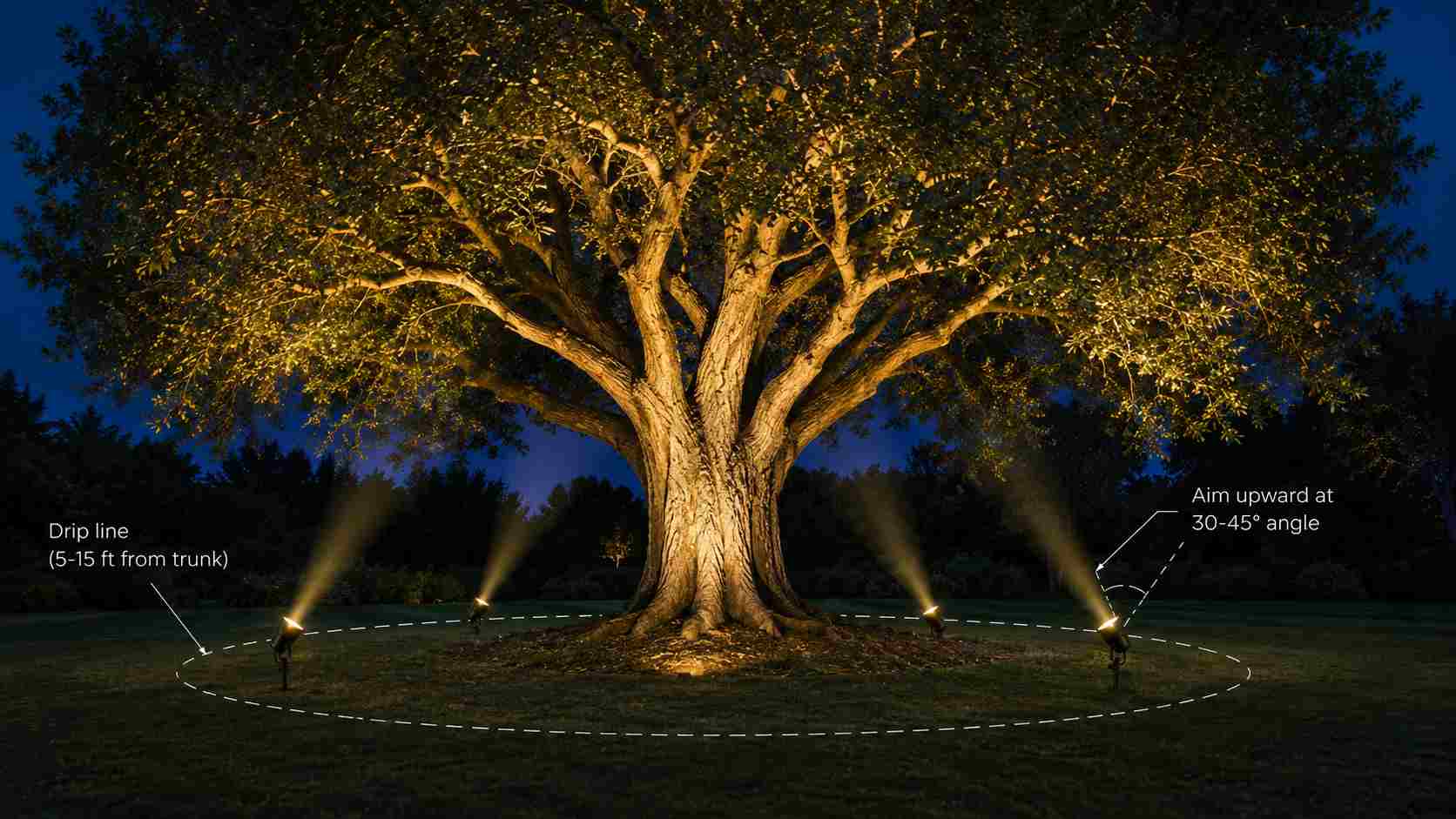
**Distance from trunk:** 5-15 feet, depending on tree size. Position at the drip line (edge of the canopy) so light travels up through branches, not straight into the trunk.
Angle: Aim the fixture so the light beam enters the lower canopy and spreads upward. Avoid aiming directly at the trunk — that creates a flat, uninteresting column of light.
Number of fixtures:
- Small trees (under 15 feet): 1-2 fixtures
- Medium trees (15-30 feet): 2-3 fixtures
- Large trees (30+ feet): 3-5 fixtures
Concealment: Hide fixtures behind shrubs, rocks, or low plantings. The magic disappears when the light source is visible.
Glare control: Check the angle from your most-used vantage points — the primary patio, living room windows, or seating areas. A fixture that looks perfect from the garden may shine directly into your eyes from the house.
What Color Temperature Works Best
| Temperature | Effect | Best For |
|---|---|---|
| 2700K-3000K (warm white) | Enhances bark warmth, inviting, natural | Most gardens, especially those with mature trees |
| 4000K (neutral white) | Clean, modern, less warm | Contemporary gardens, architectural settings |
| 5000K+ (cool white) | Clinical, harsh | Avoid — feels unnatural in gardens |
Warm white is almost always the right choice. It makes green foliage look lush and bark look rich. Cool white makes trees look washed out and artificial.
The Hierarchy of Garden Light
Not all garden lights operate at the same visual hierarchy. Some define structure. Others guide movement. A few exist purely to extend atmosphere.
Tree uplighting sits at the top of this hierarchy — it defines the identity of the space. Everything else supports it.
| Layer | Purpose | Visual Weight |
|---|---|---|
| Tree uplighting | Defines garden identity, creates vertical drama | Highest (anchor) |
| Path lighting | Guides movement, defines circulation | Medium (functional) |
| Edge lighting | Defines garden beds, adds low-level glow | Low (atmospheric) |
| Accent lighting | Highlights specific plants or features | Variable (contextual) |
Layering Uplighting with Other Garden Lights
A single uplighted tree is striking. A garden with layered lighting is transformative.
| Layer | Purpose | Recommended Product |
|---|---|---|
| Tree uplighting | Creates vertical drama, anchors the garden | Solar spotlights |
| Path lighting | Guides movement, defines circulation | Solar inground lights |
| Edge lighting | Defines garden beds, adds low-level glow | Solar LED strips (verify the current specifications) |
| Accent lighting | Highlights specific plants or features | Solar spotlights (narrow beam) |
This is the difference between structure and circulation in a garden. Trees anchor. Paths guide. Edges define. When they begin working together, the garden stops behaving like separate elements.
For a complete guide to path lighting, see our article on Garden Pathway Moonlighting.
What Happens at Dusk
Step outside just as the sky deepens from blue to indigo. The solar spotlights have been charging all day. They begin to glow — softly at first, then brighter as darkness settles.
The oak tree that disappeared into the afternoon now reveals its structure. Light catches the lowest branches, then travels up through the canopy. Shadows of leaves dance on the grass. The garden feels different now — more intimate, more intentional, more complete.
That transition — from daylight ordinariness to nighttime theater — is what hidden uplighting provides. It doesn’t just illuminate. It transforms.
Common Mistakes to Avoid
- Using a single fixture on a large tree — one light creates a spotlight effect, not canopy illumination. Use multiple fixtures.
- Placing fixtures too close to the trunk — light scrapes up the bark rather than spreading through branches.
- Visible fixtures — if you can see the light source, the magic is lost. Hide them.
- Cool white temperature — makes foliage look sickly. Stick to warm white.
- Ignoring seasonal changes — deciduous trees lose leaves in winter. The same fixture that illuminated a full canopy may look harsh on bare branches.
- Glare from primary viewpoints — always check sightlines from your main sitting areas and windows.
Installation Quick Start
- Position solar spotlights at the tree’s drip line (5-15 feet from trunk)
- Aim up through the lower canopy at a 30-45 degree angle
- Ensure the solar panel faces south (Northern Hemisphere) or north (Southern Hemisphere)
- Test placement at night — adjust angle and position as needed
- Check glare from all primary seating areas and windows
- Hide fixtures behind shrubs, rocks, or low plantings
Full charge time: 4-6 hours of direct sun provides 6-10 hours of evening illumination in optimal conditions. Expect shorter runtime in winter or shaded locations.
Maintenance
- Clean solar panels monthly — dust reduces charging efficiency significantly
- Trim vegetation that may cast shadows on the solar panel
- Adjust fixture angles seasonally as tree canopies change
- In winter, consider moving fixtures to sunnier positions
Frequently Asked Questions
Can uplighting damage mature trees?
No, when properly installed. Modern solar LED fixtures generate minimal heat. Use ground-mounted stakes rather than drilling into tree trunks.
How many solar spotlights do I need to uplight a tree?
Small trees may need one fixture. Large specimens often require 3-5 solar spotlights positioned around the drip line for even coverage.
What’s the best color temperature for tree uplighting?
Warm white (2700K-3000K) is most popular for creating an inviting, natural atmosphere that enhances bark texture and green foliage.
Do solar uplights work in winter?
Yes, but with shorter runtime. Shorter daylight hours reduce charging capacity. Position solar panels for maximum winter sun exposure and expect 4-6 hours of illumination rather than 8-10.
How far from a tree trunk should I place uplights?
Generally 5-15 feet, depending on tree size. Position fixtures at the tree’s drip line (edge of the canopy) for optimal angle through the branches.
Can I use the same solar lights for trees and pathways?
Different beam angles suit different purposes. Solar spotlights (narrow beam) work best for trees. Solar inground lights (wider distribution) are better for pathways and garden edges.
For homeowners drawn to layered garden lighting, our article on LED Strip Integration for Modern Decks explores another approach to defining garden edges and pathways.
The finest gardens are those that reveal themselves slowly after sunset.
The Bottom Line
Hidden uplighting transforms mature trees into nighttime architecture. Use warm white solar spotlights positioned at the drip line, aimed up through the canopy. Add multiple fixtures for large trees. Conceal the light sources. Layer with path and edge lighting for a complete garden illumination system.
Trees don’t become important at night by accident. They become important by design.
Turn One Beautiful Tree into a Complete Nightscape
Uplighting a mature tree can transform a garden, but the strongest result comes when that focal point works with paths, planting, boundaries and darker pauses. The Veluce Outdoor Lighting Blueprint helps you audit the garden after dark, define priority zones, choose the lighting effect before the fixture, and build the whole scheme deliberately.
Explore More
Browse the VELUCE shop → VELUCE Collection
Save ideas for later → VELUCE on Pinterest